|
|
The Landsat Image Mosaic of Antarctica Robert Bindschadler, Patricia Vornberger, SAIC Andrew Fleming, British Antarctic Survey Adrian Fox, British Antarctic Survey Jerry Mullins, USGS Douglas Binnie, Sara Jean Paulsen, Brian Granneman, Abstract The Landsat Image Mosaic of Antarctica (LIMA) is the first
true-color, high-spatial-resolution image of the seventh continent. It is constructed from nearly 1100 individually
selected Landsat-7 ETM+ scenes. Each
image was orthorectified and adjusted for geometric, sensor and illumination
variations to a standardized, almost seamless surface reflectance product. Mosaicing removed nearly all clouds producing
a high quality benchmark data set of Introduction Landsat imagery represents the oldest continuous satellite
data record of the Earth’s changing surface.
Milestones in this record are represented by the production of mosaics
of all the continents, except The Long Term Acquisition Plan (Arvidson et al., 2001), used to manage the scheduling of imagery from the Enhanced Thematic Mapper Plus (ETM+) sensor on-board the Landsat-7 satellite, included the annual collection of thousands of Landsat images of Antarctica beginning in 1999. These data form the basis of the mosaic described here. It is referred to as the Landsat Image Mosaic of Antarctica (LIMA) There were many steps required to produce the final products
that are now publicly viewable and available on the web site http://lima.usgs.gov/. These steps are described here to give
interested users a more complete understanding of the reasoning and of the methods
applied in the selection, processing, enhancement and management of the nearly
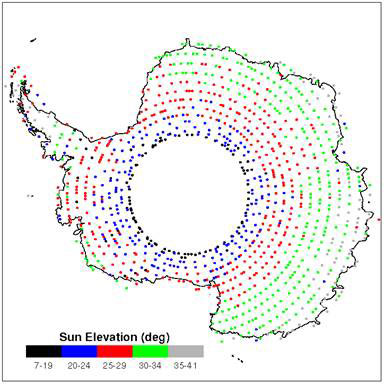
1100 individual images that comprise The care employed in the production of Scene Selection Landsat-7 ETM+ scenes were the preferred source of all LIMA data for three principal reasons: the geo-location of the data has been characterized to have a one-sigma accuracy of +/- 54 meters (Lee and others, 2004); extensive imaging campaigns of Antarctica undertaken soon after the April 1999 launch of Landsat-7 provided a large number of available images during the first few years of sensor operations; and the existence of a 15-m panchromatic band provided the highest spatial resolution available with any Landsat sensor. Individual scenes to be used in A number of factors were weighed in the decisions of which
scenes to use in At one stage, a small number of ASTER images were considered as a viable means to replace a cloudy portion of Landsat images, however, in the final analysis, the color balancing became too difficult and the ASTER scenes were omitted from the final mosaic.
Figure 1. Scenes selected for use in Level-1 Processing All scenes selected for The three DEMs were intercompared at a 5 km resolution (the
supplied post spacing of both the ICESat and radar altimeter-ICESat DEMs). Differences were examined to help discern how
they might affect the orthorectification process in different parts of Conversion to Surface Reflectance Many steps were required to convert the radiance measured at the ETM+ sensor to an accurate value of surface reflectance. These are discussed below in the order they were applied to the NLAPS-processed data. Saturation AdjustmentThe high reflectance of snow at optical wavelengths can saturate the ETM+ sensor. Saturation radiance thresholds vary by band, by gain setting (High or Low) and by illumination geometry (sun elevation and surface slope). Table 1 indicates the saturation radiance, Lmax, for ETM+ bands (both High and Low gain setting).
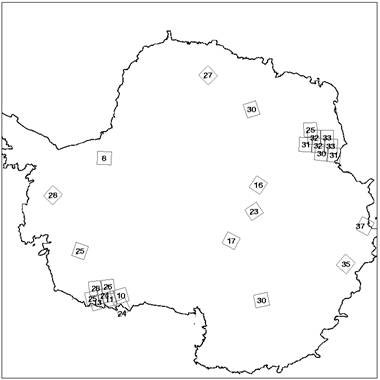
Table 1. ETM+ The spectral reflectance of snow varies with the specific type of snow (primarily snow grain size and wetness). In general, snow is most reflective in Band 1, decreasing through Bands 2 and 3, decreasing to even lower values in Band 4 and decreasing to very low values in Bands 5 and 7 (see Dozier and Painter, 2004, for a review of multispectral remote sensing of snow). As snow ages, the snow grain size increases, and reflectance decreases at all optical wavelengths. Failure to adjust for saturation will cause saturated image pixels to be converted to an incorrect spectral reflectance that is lower than the actual reflectance, and produce improper colors in multi-band composite images. Saturation adjustment is completed before any other adjustment because it is easiest to identify saturation at this early stage of image processing by the test condition that a pixel value is saturated (Digital Number (DN) = 255, the maximum value for the 8-bit data range of ETM+). DNs correspond to a band-specific scaled radiance value, but the conversion to radiance is made after the saturation adjustment discussed here. Saturation values (DN=255) of a given pixel are adjusted to DN values greater than 255 by applying a predetermined spectral ratio to an unsaturated band value at the same pixel. The appropriate spectral ratio was determined by examining 27 Landsat scenes across Antarctica that were selected to provide a variety of surfaces, a variety of sun elevation values and all three gain combinations of spectral bands used for ETM+ acquisitions of Antarctica (see Figure 2 and Table 2).
Figure 2. Location of
27 Landsat ETM+ scenes used to determine empirical relationships for saturation
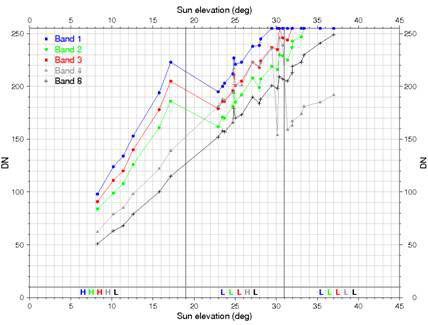
adjustment and non-diffusive reflectance of The distribution of DN for snow pixels within each image was checked to be normally distributed and the DN of the histogram peak for each band in each scene was identified. The DN value of the histogram peak depended strongly on sun elevation, with lower DN values for lower sun elevations (Figure 3). Band 1 always had the highest snow-histogram maximum DN value, Band 3 was somewhat lower, then Band 2, followed by Band 8. The relative position of Band 4 depended on its gain setting—the gains of Bands 1, 2 and 3 were always either all High or all Low, depending on sun elevation, while Band 4 was switched independent of any other band. Band 8 always remained at Low gain. Bands 5 and 7 were not considered. These interband relationships are consistent with snow spectra of aging snow collected in the field (Dozier and Painter, 2004).
Figure 3. DN of the snow histogram maximum plotted
versus sun elevation for each band of the 27 ETM+ scenes indicated
in Figure 1. Gain settings for Bands 1-4
and 8, indicated by H and L along the bottom of the plot, were tied to sun
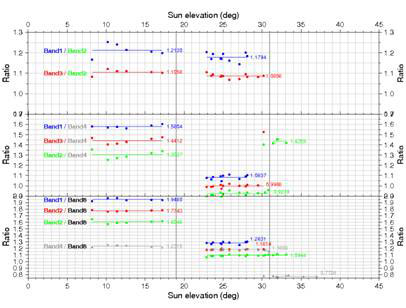
elevation. Band-to-band spectral ratios were calculated from the data plotted in Figure 3. They are very consistent for the same gain combination and indicate no dependence on sun elevation (Figure 4). These ratios are also given in Table 2. Their consistency forms a sound basis for our saturation adjustment methodology.
Figure 4. Band-to-band
ratios versus sun elevation derived from Figure 3 values. Table 2. Spectral band ratios of DN for snow regions of the 27 sample scenes indicated in Figure 2. Gain settings are given as High (H) or Low (L) in order of bands 1, 2, 3, 4, 8.
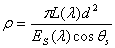
In applying this saturation adjustment to the LIMA scenes, every pixel in every scene was examined for saturation in the following band order: 1, 3, 2, 4. If saturation was identified (DN=255), then the pixel’s value in Band 2 is used along with the appropriate spectral band ratio (depending on the relative gain settings, see Table 2) to adjust the saturated DN value to a higher value based on the DN value of the unsaturated band. If Band 2 is also saturated, then Band 8 is used, with the appropriate spectral ratio (see Table 2). Sensor Radiance to Surface Reflectance ConversionThe ETM+ sensor was frequently calibrated to maintain an accurate conversion of the DN value to the at-sensor radiance (see Chapter 9 of the Landsat-7 Science Data Users Handbook at http://landsathandbook.gsfc.nasa.gov/handbook/handbook_toc.html). These calibration coefficients are included in the header files of every NLAPS-processed Landsat scene. The conversion from DN to at-satellite radiance is accomplished by applying the following equation: L(λ) = {[Lmax(λ) – Lmin(λ)]/255} * DN + Lmin(λ) (1) Where L(l) is the spectral radiance at the sensor’s aperture, and Lmin(l) and Lmax(l) are the spectral radiances that correspond to DN=0 and DN=255, respectively (see Table 1). Radiances are given in W/m2*ster*mm. From these calibration values, the conversion of at-sensor radiance to planetary reflectance follows from:
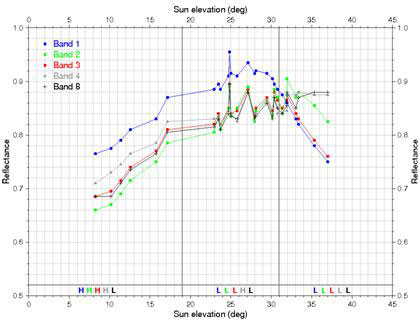
Where r is planetary reflectance, d is the Earth-Sun distance (in AU), Es(l) is the mean solar exoatmospheric irradiance, and Js is the solar zenith angle (in degrees) (see Chapter 11 of the Landsat-7 Science Data Users Handbook). Converting planetary reflectance to surface reflectance usually involves the use of an atmospheric scattering model. Such models require input values of atmospheric water vapor and aerosols. The atmosphere over most of the Antarctic continent is very cold, minimizing the amount of water vapor, and very clean, minimizing the concentration of aerosols. The assumption made here is that these atmospheric corrections are negligible and the planetary reflectance is a good approximation of the surface reflectance. The cosine dependence of the surface brightness results from the fact that the illuminated surface area per solid angle of incoming solar radiation varies with the cosine of the sun elevation angle. This situation strictly only applies for a horizontal surface. For sloping surfaces, the slope component in the direction of the solar illumination must be added to the sun elevation angle. It is this additional factor that allows the surface topography of the ice sheet to be visually discerned by brightness variations in Landsat images of the ice sheet. Calculated reflectance values in excess of 100% are not uncommon in sloping snow covered terrain when the surface slope is not included in Equation 2. Local Sun Elevation AdjustmentAt high latitudes, the local sun elevation varies significantly (i.e., a few degrees) across a Landsat scene. This requires the solar elevation in Equation 2 to be the local sun elevation angle at each pixel and not the scene-center value. The local sun elevation angles are calculated by using a solar ephemeris to calculate the solar elevation at each of the four scene corners for the time and date of the scene center. The solar elevation at each pixel is then calculated using a bi-linear interpolation of the four scene-corner sun elevations. Correction for non-Lambertian ReflectanceThe DN-to-surface reflectance conversion employed by Equation 2 assumes the reflectance character of the surface is Lambertian and that the Landsat sensor views the surface from directly overhead. While the second assumption is generally valid, even at the image edges, the first is not. At progressively lower sun elevations, snow deviates from the properties of a Lambertian, perfectly diffusive reflector due to increasing forward scattering (Warren et al., 1998, Masonis and Warren, 2001). Field studies of this effect provide limited quantitative estimates of this non-Lambertian effect. We also draw upon an empirical form of this relationship based on the same 27 Landsat scenes referenced above (Figure 2). Figure 5 shows how the surface reflectance, calculated from Equation 2, varies with sun elevation. In this figure, the Band 1 reflectance decreases as sun elevation increases beyond 27 degrees and Band 2 and 3 reflectances decrease as sun elevation increases beyond 31 degrees due to saturation. These decreases are not a real effect, rather, they are the result that a saturated sensor reading of 255 underestimates the actual at-sensor radiance and this underestimate of radiance is converted, through Equation 2, to an underestimate of reflectance.
Figure 5. Surface reflectance versus sun elevation for the 27 Landsat
scenes indicated in Figure 2. Surface
reflectances are calculated from Equation 2 without any saturation adjustment
applied. Saturation adjustment, as described above, corrects the
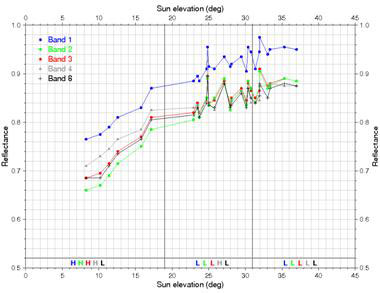
artificial surface reflectance decrease at higher sun elevations (Figure 6). What remains is the non-Lambertian effect of
decreasing surface reflectance as sun elevation decreases. This affects nearly all sun elevations in the
Figure 6. Surface reflectance versus sun elevation (see Figure 5) after
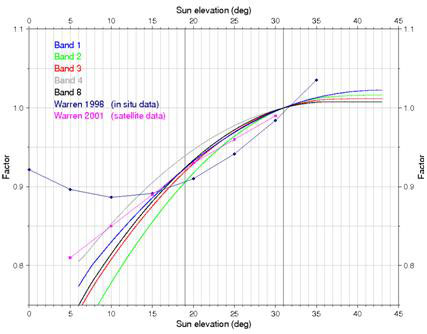
saturation adjustment. Our adjustment for the non-Lambertian reflectance effect takes the form of an adjustment ratio for each spectral band. The purpose of this adjustment is to increase the calculated reflectances at lower sun elevations to what the reflectance would have been if the surface were a Lambertian reflector or if they had been illuminated with the same solar elevation. These ratios were determined initially by fitting quadratic curves to the non-saturated data pairs of surface reflectance versus sun elevation, i.e. the data in Figure 6 were fitted by quadratic curves, and dividing those fitted values by a “standard” reflectance value for each band. The initial ratios contained slight biases that were subsequently removed by fitting a line to the adjusted reflectances and modifying the ratios so that the mean of the adjusted reflectances for each band matched the standard reflectances. The standard reflectance values were chosen based on the observation that our derived reflectance values agreed with field data at 31 degrees solar elevation (Masonis and Warren, 2001). These values are given in Table 3. The field data are limited to 600nm wavelength—in the absence of other field data we assume here that a similar correlation applies at all wavelengths. The resulting ratio values are shown in Figure 7 along with a similarly calculated set of ratios for the field data. Surface reflectances calculated for saturated pixels are included in Figure 6, but excluded from the quadratic fits and the non-Lambertian adjustment ratios. Table 3. “Standard”
spectral reflectance for snow
Figure 7. Non-Lambertian adjustment ratio versus sun elevation derived
from 27 Landsat scenes shown in Figure 1 and for field data (from Masonis and Warren,
2001). Reflectance NormalizationOur final adjustment to surface reflectance is not
physically based, but motivated by the desire to produce a visually consistent
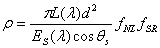
mosaic by eliminating visually distracting edges between adjacent scenes. To implement this final adjustment, the reflectance histogram of each scene is quantified for each band using a reflectance binning interval of 0.004. Once quantified, the histogram bin above 0.5 reflectance that has the greatest number of occurrences is determined, and the reflectance value of that bin is compared with the corresponding “standard” spectral reflectance. A “reflectance normalization” ratio (equal to the “standard” reflectance divided by the actual reflectance) is then applied to the entire scene to force the maximum reflectance occurrence to match the “standard” spectral reflectance. A ratio approach is used to minimize the changes for lower reflectance regions, e.g. rock. After accounting for all of the above adjustments, the actual equation that is applied is of the same form as Equation 2, but modified to the following:
where fNL
is the adjustment ratio for non-Lambertian reflectance, and fSR is the histogram-based
“reflectance normalization” adjustment ratio to the “standard” snow reflectances.
These spectral reflectance shifts are
recorded in an ancillary data file to ensure that the adjustments are preserved
and are available to Reserving the non-physical adjustment to the last of the
series of adjustments described in this section provides a measure of the
success of the earlier adjustments in creating a high-quality data set of
uniformly treated scenes. In practice,
most Mosaicing Once the individual scenes have been adjusted, they were mosaiced together using customized software developed by ITT VIS to be used within the ENVI image processing environment. The mosaicing procedure began by determining a stacking order of scenes (the single value of any pixel comes from the uppermost scene with a value for that pixel) and then omitting unwanted portions of scenes, such as clouds, to allow preferred portions of scenes lower in the stack to show through. In practice, many clouds present in the selected scenes were effectively removed by ensuring that another scene, with corresponding cloud-free pixels was placed higher in the image stack. Although every attempt was made to normalize the
reflectances of all the scenes, the adjustments detailed above were only
performed to entire scenes. There were a
few instances where there were reflectance variations within a scene that caused
a visual mis-match between it and all its neighboring scenes. In this case, judicious trimming of scene boundaries
was employed to minimize these visually disruptive scene-to-scene jumps in
reflectance. Any residual mismatch in
adjacent scene color balance was removed by applying band-specific adjustments
based on local histogram statistics.
These adjustments are recorded in the The most difficult area to produce a visually smooth mosaic was around the ice sheet margin where temporal variations of the sea ice pack and changes in the extent of ice shelves produced inevitable discontinuities in adjacent scenes, but inevitably some edges remain. Again, these were minimized through suitable trimming and stacking of adjacent scenes. Further there are a small number of areas where it was not possible to identify suitable cloud free imagery and patches of cloud are still present. As more suitable imagery of these regions becomes available these portions will be updated. The data volume of so many scenes required that the mosaic be prepared in a series of 25 smaller blocks, each composed of 24 to 76 individual scenes. This “building block” structure was incorporated into the mosaicing software allowing blocks, once completed, to be combined through output instruction files into a larger mosaic. In fact, the full continental mosaic never existed as a single file, rather only as a “virtual mosaic”—a series of separate image files (each a combination of a few blocks) linked by a control file that could guide subsequent operations on the mosaic exactly as if the mosaic actually did exist in a single file. This approach avoided the need for extremely large files and the associated storage and file input/output problems that can accompany very large files. From this mosaicing operation and the virtual mosaics that were created (one for every spectral band), a series of geotiff tiles were created that covered the entire continent. 170 geotiff tiles were produced because the maximum allowable size of a geotiff file is 2 gigabytes. The tile pattern was created to ensure that the production of the various multiband composites and contrast-stretched enhancements (described in the next section) would also not exceed the geotiff size limitation using the same tile arrangement. Data Precision Any description of a new data set requires a careful explanation of data precision. This topic perhaps is best presented at this juncture between the end of the data processing procedures and the beginning of the generation of display products. Much earlier, it was mentioned that the NLAPS processing of individual scenes produced multiband data with 8-bit precision. An 8-bit representation imposes an upper bound to the accuracy due to the number of quantization levels. This quantization constraint is consistent with the noise levels of the multispectral bands and of the panchromatic band of the ETM+ sensor, approximately 1 DN and 2 DN, respectively (Scaramuzza et al., 2004). All of the post-NLAPS processing steps described above
carried a 16-bit level of precision to the various data adjustments. This was important to allow these refinements
to have their full effect and not be lost in truncations or roundings of the very
last bit of the 8-bit data values. With
the extra range afforded by 16-bit data, the spectral reflectances are
calculated to the nearest 1/100 % (i.e., a value of 10,000 represents a
reflectance of 100%). To preserve the
highest level of Most computer displays require 8-bit gray-scale signals, or 24-bit color signals (three bands for the red, green and blue color guns, each in 8-bit). For this reason, the various display products described below are all generated as 8-bit single band, or 24-bit color composites. Enhancements Digital imagery enables enhancement of the visual
representation of the digital data through the use of different assignments of
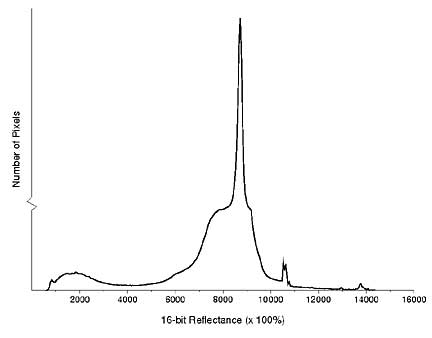
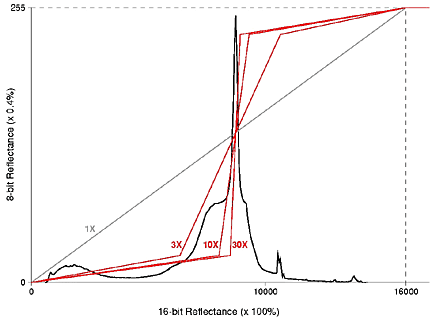
the original data values to those displayed on a computer monitor. These methods are very appropriate to Figure 8 is a histogram of a typical scene fully processed
for
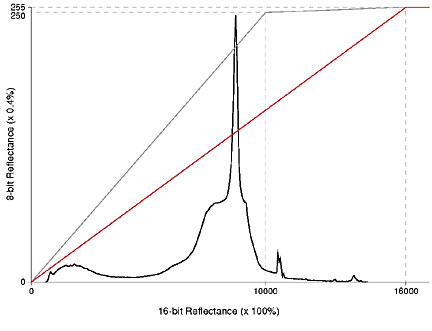
Figure 8. Representative histogram of 16-bit reflectance values for a Pan-SharpeningThe This convenient alignment is used to increase the resolution of the spectral bands with a simple algorithm. Each 30-meter spectral band pixel is subdivided into four 15- meter pixels. For a specific pixel, let S be the initial pixel value and let s1, s2, s3 and s4 be the values to be assigned to the 15-meter subdivided pixels. The four panchromatic pixel values (p1, p2, p3, p4) are averaged together to a mean value of P and the spectral values are then calculated as: s1 = S * p1/P s2 = S * p2/P s3 = S * p3/P s4 = S * p4/P This formulation has the additional property that the original 30-meter spectral values can be recovered by averaging the pan-sharpened 15-meter pixels. Base CompositesColor composites are produced by converting the single-band, pan-sharpened 16-bit values at each pixel to 8-bit single band values and combining three bands into a 24-bit color product. An 8-bit number cannot be larger than 255 (starting at 0). To compress the 16-bit range of reflectances into this narrower range, each 16-bit reflectance value (in hundredths of percent) between 0 and 10,000 is divided by 40. Thus, 100% reflectance is converted to a value of 250. To convert any 8-bit value to the corresponding reflectance value (in percent), it must be divided by 2.5. Reflectances in 16-bit data above 10,000 (and below the maximum value of 16,000) are converted to 8-bit values between 250 and 255. The specific equations used are: r = R/40 0<R<10,000 r = R/1200 + 241.67; 10,000<R<16,000 r = 255; 16,000<R where R is the 16-bit value and r is rounded to the nearest 8-bit value excluding r=0. The difference between the divisor of 40 for the reflectance range 0-100% and the divisor of 1200 for reflectances above 100% means that very bright reflectances (such as can occur on the sun-lit sides of steep snow-covered mountains) are highly compressed into a very narrow range of values in the 8-bit representation of LIMA. An example of this effect is illustrated later and a later enhancement is designed to relax this data compression of very bright values at the expense of compressing darker data pixels. Figure 9 illustrates this 16-bit to 8-bit conversion by the thin black line that matches any 16-bit number on the horizontal axis with the converted 8-bit number on the vertical axis.
Figure 9.
Histogram of typical LIMA 16-bit reflectances with the thin black line showing
the conversion from the16-bit reflectance values to 8-bit reflectance values
for the basic (no-stretch) enhancement, and the red line showing the conversion
from the16-bit reflectance values to 8-bit reflectance values for the 1X
(sunglasses) enhancement. To preserve the color balance through this 16-bit to 8-bit conversion (and all the others that follow), it is applied only to Band 2 (green). The corresponding values for the other bands (1, 3 and 4) are calculated by scaling the enhanced (8-bit) values by the ratio of the unenhanced (16-bit) reflectances. Thus, if G and g are the unenhanced and enhanced values of Band 2, respectively, and B is the unenhanced value of Band 1, then the enhanced value of Band 1, b, is: b = g * B/G Similar equations hold for Bands 3 and 4. Two “base”, i.e., unenhanced, products are produced from
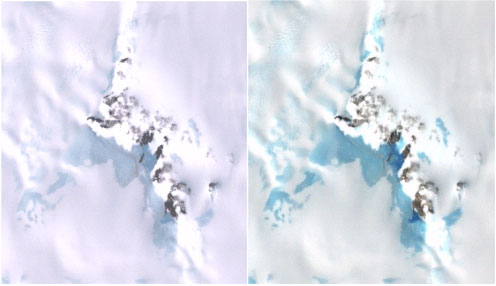
this 16-bit to 8-bit conversion of spectral Bands 1 through 4. One is a combination of Bands 3, 2, and 1
into the red, green and blue channels.
Because of the spectral locations of these bands, this produces a
true-color representation of
Figure 10. Comparison of the 321
(left) and the 432 (right) color composites for a region of North Victoria Land
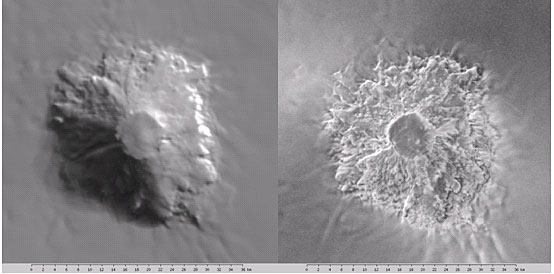
in EnhancementsSubtle variations of the The first enhancement is designed to accentuate very bright reflectances (over 100%) that were strongly compressed in the base composites. To accomplish this, the bilinear enhancement of the base composites described above is modified to a single divisor of 62.745(=16,000/255). This enhancement has two major results. One is that the reflectances above 100% are now represented by a larger portion of the 0-255 range of 8-bit values, allowing the spatial variations to be seen more easily. The other result is that the reflectances in the 0 to 100% range will not only be distributed over a smaller portion of the 0-255 8-bit range than before, thus sacrificing some visual detail, but they will also be represented by lower values, making these pixels appear darker than in the base composites. The specific equations used are: r = R/62.745 0<R<16,000 r = 255; 16,000<R where R is the 16-bit value and r is rounded to the nearest 8-bit value excluding r=0. The red line in Figure 9 illustrates this enhancement and helps illustrate why the snow surfaces appear darker with the enhancement than in the base composites. An illustration of the 1X enhancement is given in Figure 11. This enhancement acts much like wearing a pair of sunglasses and so is termed the “sunglasses” enhancement. Both true-color (321) and false-color (432) composites are formed from these enhanced bands.
Figure 11. LIMA sub-image of Mt. Takahe in West Antarctica with the 321
true-color composite (left) and with the 1X “sunglasses” enhancement
(right). Details of the sun-facing slope
appear “overexposed” in the left sub-image and more visible in the 1X
enhancement. The remaining enhancements are all aimed at increasing the
visual appearance of detail in the flatter ice sheet surface which, in terms of
relative area, dominates In the 3X case, called the “low-contrast” enhancement, the specific equations applied are: r = R/253.76; 0<R<6344 r = R/20.915 – 278.3075; 6344<R<10,631 r = R/214.76 + 180.498; 10,631<R<16,000 r = 255; 16,000<R where R is the 16-bit value and r is the 8-bit value excluding r=0. Figure 12 illustrates the nature of this enhancement superimposed on the representative histogram.
Figure 12.
Histogram of typical LIMA 16-bit reflectances showing the conversion
from the16-bit reflectance values to 8-bit reflectance values for the 3X “low-contrast”,
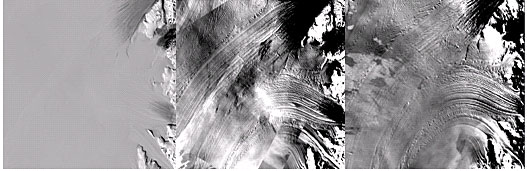
10X “medium-contrast”, and 30X “high-contrast” enhancements. The “medium-contrast” enhancement provides an even stronger (10X) stretching of the dominant ice-sheet surface reflectances to reveal even finer details of the snow surface. The specific equations applied are: r = R/320.52; 0<R<8013 r = R/6.2745 -1252.03; 8013<R<9299 r = R/268.04 + 195.307; 9299<R<16,000 r = 255; 16,000<R where R is the 16-bit value and r is the 8-bit value excluding r=0. Because the differences between the true-color and false-color composites are so slight, only a true-color composite is produced. The “high-contrast” enhancement applies the strongest (30X) contrast stretch to the 16-bit data to show the most subtle features contained in the imagery. The specific equations applied are: r = R/339.60; 0<R<8490 r = R/2.0915 – 4034.075; 8490<R<8918 r = R/283.28 + 198.519; 8918<R<16,000 r = 255; 16,000<R where R is the 16-bit value and r is the 8-bit value excluding r=0. Once again, only a true-color composite is produced. In each of these contrast enhancement cases, the equations are applied to the 16-bit, pan-sharpened Band 2 mosaic. Other bands are converted to 8-bit values to preserve the color balance (as described above) and true-color (321) and false-color (432) composites are generated. Because the middle segment of this enhancement is pivoted on the same value as in the first enhancement (Figure 9), the overall ice-sheet appearance of the contrast enhancements will appear similar to the 1X enhancement, i.e. darker than the base composites, but that areas that were either very dark or very bright in the base composites will appear even darker and even brighter, respectively, in each contrast enhancement. An example of the successively stronger contrast enhancements is shown in Figure 13.
Figure 13.
Sample of the contrast enhancements progressing (left to right) from no
enhancement to 3X, 10X and 30X, for a portion of the megadune area of Because
Figure 14.
Sample of the customized enhancement of a region of two merging glaciers
showing the ability of the 16-bit Complementary MosaicsAlthough Both
Figure 15.
Sub-images of Mount Takahe, West Antarctica, in the MODIS Mosaic of
Antarctica (left) and the Radarsat mosaic of Antarctica (right). Each image is approximately 48 km on a side. Web Services The World Wide Web provides an excellent medium for
researchers and the public to interact with The USGS web site also includes the Interactive Atlas of
Antarctic Research, where a variety of other map-based data layers can be
displayed simultaneously with An associated web site (http://lima.nasa.gov)
focuses on education and outreach activities using Summary The Landsat Image Mosaic of Antarctica represents a major
advance in the ongoing digital record of our planet. It provides researchers and the public with
the first-ever high spatial resolution, true-color mosaic of this
continent. The nearly 1100 images used
to construct the mosaic are now freely available as individual scenes, as a
nearly seamless mosaic and in a variety of enhancements designed to highlight
meaningful details of the surface. Most
of the images fall within the four-year period from 1999 to 2003, making this
data set an important milestone in the accelerating evolution of the Antarctic
continent. As such, The processing of the image data was held to a rigorous standard that preserved the values of each pixel through a complex series of deterministic adjustments. Image data were initially processed from raw data and orthorectified. Thereafter, a combination of sensor calibrations and empirically-determined adjustments converted the data to surface reflectance values in multiple spectral bands. The precise adjustments for each image are available as metadata. This rigor sets a new standard in the quality and value of large-scale mosaics with Landsat imagery. Enhancements of these data included pan-sharpening to
increase the spatial resolution, and an assortment of contrast stretches to
illuminate different features of the Antarctic continent. It is anticipated that the variety of
enhancements will supply any user with a sufficiently wide range of readily
accessible views of Acknowledgements This project was supported by the National Science Foundation through grants #0541544 to NASA and #0233246H to USGS and by the British Antarctic Survey. It is regarded as a major benchmark data set of the International Polar Year. References Arvidson , T., J. Gasch and S.N. Goward, 2001. Landsat 7's long-term acquisition plan - an innovative approach to building a global imagery archive, Remote Sensing of Environment, Vol. 78, No. 1-2, p. 13-26. Dozier,
J. and T.H. Painter, 2004. Multispectral and Hyperspectral Remote Sensing of Alpine Snow Properties,
Annual Reviews of Earth and Planetary
Science, Vol. 20, p. 465-94. Jezek, K., and the RAMP Product Team, 2002. RAMP AMM-1 SAR
Image Mosaic of Lee, D.S., J.C. Storey, M.J. Choate, and R.W. Hayes, 2004. Four Years of Landsat-7 On-Orbit Geometric Calibration and Performance, IEEE Transactions on Geoscience and Remote Sensing, Vol. 42, No. 12. Masonis,
S.J. and S.G. Warren, 2001. Gain of the AVHRR visible channel as tracked using bidirectional
reflectance of Antarctic and Scaramuzza, P.L., B.L. Markham, J. A. Barsi, and E. Kaita, 2004. Landsat-7 ETM+ On-Orbit Reflective-Band Radiometric Characterization, IEEE Transactions on Geoscience and Remote Sensing, Vol. 42, No. 12, p. 2796. Warren, S.G., R.E. Brandt and P. O’Rawe Hinton, 1998. Effect of surface roughness on bidirectional reflectance of Antarctic snow, Journal of Geophysical Research, Vol. 103, No. E11, pp. 25,789-25,807. | ||||||||||||||||||||||||||||||||||||||||||||||||||||||||||||||||||||||||||||||||||||||||||||||||||||||||||||||||||||||||||||||||||||||||||||||||